
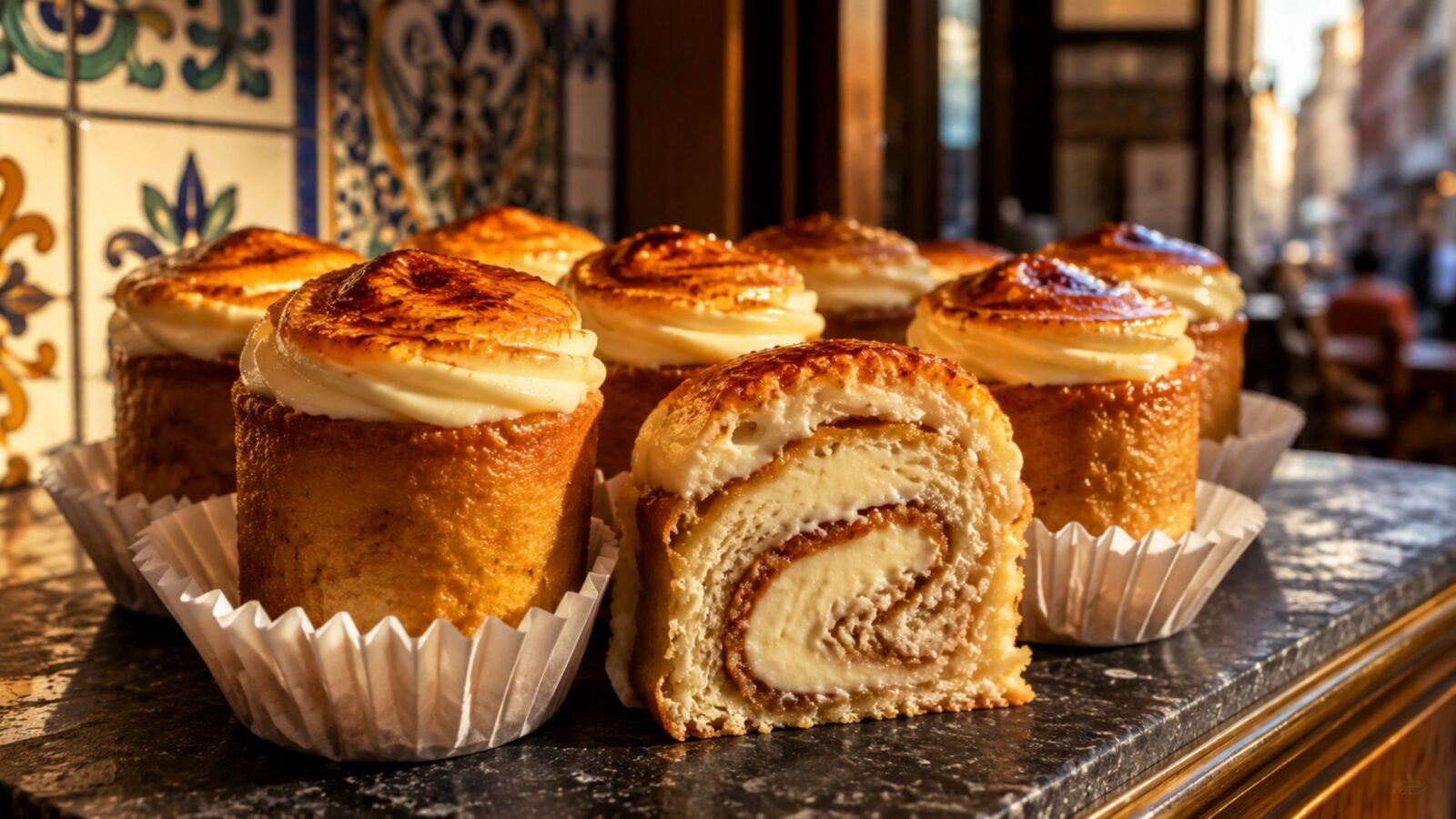

The wrong search can lead to an entirely different dessert; the right one leads to a syrup-soaked, cream-crowned bite with more than a century of Granada history.
Searching for the best Piononos de Santa Fe near me sounds straightforward. It is not. Across Spain, Latin America, Puerto Rico and the Philippines, the word pionono can refer to desserts—and sometimes savoury dishes—that bear little resemblance to the small pastry created in Santa Fe, Granada.
The authentic Granada-style pionono is a compact cylinder of thin rolled sponge, moistened with syrup, layered with cream and cinnamon, then finished with a caramelised cream crown. It is generally eaten in one or two bites rather than served as a large sliced cake.
Location also matters. A bakery may advertise “pionono” while selling an Argentine sponge roll, a Filipino pianono or a Puerto Rican plantain dish. Searchers looking for the Santa Fe original should verify the shape, filling, toasted top and bakery provenance before making a special journey.
BLUF: The strongest evidence-based choice for authentic Piononos de Santa Fe is Casa Ysla, founded in Santa Fe in 1897 and still operating multiple branches across Santa Fe and Granada. Start with its A-92 flagship or Calle Real shop; in central Granada, Bib-Rambla and Acera del Darro are the most practical stops.
Five Strong Options, Ranked by What the Searcher Actually Needs
There is no independently audited league table proving that one bakery produces the objectively “best” pionono. A more defensible comparison considers provenance, recipe continuity, location, freshness and accessibility.
| Bakery and location | Best suited to | Why it deserves consideration |
|---|---|---|
| Casa Ysla, A-92-G Km 3.3, Santa Fe | The historical baseline | This Santa Fe site is connected directly with the bakery that identifies itself as the creator of the original pionono and remains the brand’s principal production and visitor location. |
| Casa Ysla, Calle Real 10, Santa Fe | Visitors exploring Santa Fe town centre | It offers the Casa Ysla recipe within Santa Fe itself, without requiring travellers to rely solely on the larger roadside establishment. |
| Casa Ysla, Plaza Bib-Rambla 22, Granada | Sightseers staying in central Granada | The official store directory confirms this branch in one of Granada’s most convenient central squares. It is the practical choice when authenticity matters but travelling to Santa Fe does not fit the itinerary. |
| Casa Ysla, Acera del Darro 62, Granada | A central café stop near Puerta Real | This verified branch provides another accessible Casa Ysla option in Granada’s commercial centre. |
| Pastelería López-Mezquita, Reyes Católicos 39, Granada | Comparing a traditional independent interpretation | López-Mezquita is a long-established Granada pastry shop associated with piononos and other regional sweets. Availability and opening times should be confirmed before travelling. |
| Casa Pasteles, Plaza Larga 1, Albaicín | Atmosphere and an Albaicín pastry stop | Casa Pasteles traces its operation to 1928 and occupies a prominent location in Plaza Larga. Independent visitor sources frequently mention its piononos, but same-day stock should be verified directly. |
The current Casa Ysla store directory lists 15 establishments in Granada province and additional branches in Almería and Jaén. The network includes Santa Fe, central Granada, Albolote, Armilla and Churriana de la Vega, making it the easiest verified source when searching within eastern Andalusia.
The practical ranking
- Best for first-time authenticity: Casa Ysla in Santa Fe
- Best without leaving central Granada: Casa Ysla at Plaza Bib-Rambla
- Best for comparing another traditional style: López-Mezquita
- Best paired with an Albaicín walk: Casa Pasteles
- Best for convenient takeaway: Whichever verified Casa Ysla branch is closest and has fresh stock
The Three-Part Test That Exposes an Imitation
An authentic Pionono de Santa Fe is not simply a Swiss roll cut into sections. Its identity depends on three connected components.
1. A small, upright sponge cylinder
The sponge should be thin, flexible and rolled into a compact vertical form. It is not normally presented as a broad horizontal roulade or a large cake slice.
2. A moist interior rather than a dry crumb
Syrup gives the pastry its characteristic soft, almost melting texture. The sponge should hold together, but dryness is a warning sign. Casa Ysla’s production description refers to syrup being applied before the sponge is rolled with cream and cinnamon.
3. A toasted cream crown
The upper surface should carry a small cap of cream with caramelised sugar. This browned crown is central to the pastry’s visual identity and distinguishes it from plain cream rolls and packaged sponge cakes. The official Andalusian tourism description likewise identifies the rolled base and toasted cream top as the defining structure.
Authentic pionono snapshot
- Place of association: Santa Fe, Granada, Andalusia
- Modern form associated with: Ceferino Isla
- Commercial origin date: 1897
- Core structure: Rolled sponge, syrup, cream and cinnamon
- Top finish: Toasted or caramelised cream
- Typical size: One or two bites
- Expected texture: Moist, tender and creamy
- Best tasting approach: Fresh, with unsweetened coffee or tea
These characteristics are consistently described by Casa Ysla, Andalusian tourism materials and Spanish food reporting.
Editorial tasting rule: Establish the traditional Santa Fe version before trying chocolate, fruit, ice-cream or restaurant reinterpretations. Otherwise, there is no reliable baseline for judging whether an innovation preserves the original pastry’s balance.
Why Santa Fe Became the Pastry’s Reference Point
The current form of the pionono is generally attributed to pastry maker Ceferino Isla González, who established his bakery in Santa Fe in 1897. He reportedly shaped and named the pastry in honour of Pope Pius IX—Pío Nono in Italian usage—with the cylindrical body suggesting papal robes and the caramelised crown evoking the Pope’s skullcap.
That origin story requires one qualification. References to sweets called pío nono predate Casa Ysla, and Spanish food historians have also noted possible links to earlier Hispano-Muslim confectionery traditions involving syrup, spices and cinnamon. The defensible distinction is that Ceferino Isla is associated with the small, upright, cream-crowned Santa Fe format recognised today—not necessarily with every earlier dessert carrying a similar name.
Casa Ysla remains the central commercial reference. In 2025, El País reported production of approximately 50,000 piononos per week, with a network of company shops and distribution points. The same report noted that other Granada bakeries now produce their own versions, each adjusting syrup, spice, cream and preparation methods.
The pastry is also recognised by the official Andalusian tourism authority as one of Granada’s defining regional sweets. Its tourism guidance specifically directs visitors toward the traditional Santa Fe product rather than treating pionono as a generic rolled cake.
Turning “Near Me” Into a Search That Produces the Right Dessert
Generic map searches can confuse several unrelated products. Use a more precise query sequence.
Search these exact phrases
- “Piononos de Santa Fe near me”
- “Pionono granadino near me”
- “Spanish Santa Fe pionono bakery”
- “Casa Ysla nearest branch”
- “Pastelería granadina piononos”
Adding Granada, Santa Fe, Spanish or granadino filters out many Latin American and Filipino results.
Examine photographs before trusting the listing
A Santa Fe pionono should appear as a small upright cylinder with a golden or dark caramelised top. Large spiral slices, jelly rolls, plantain cups or savoury meat fillings indicate a different regional dish.
Ask the bakery four direct questions
- Is this the Granada or Santa Fe style of pionono?
- Is the sponge soaked in syrup?
- Is it filled and topped with pastry cream?
- Is the cream crown caramelised before sale?
A bakery unable to answer these questions may be using the name loosely.
Check recency, not merely star ratings
Recent product photographs, menu updates and customer comments are more useful than an accumulated rating covering several years. Piononos are freshness-sensitive pastries, and a highly rated bakery may not prepare them every day.
Outside Spain, verify before travelling
Permanent specialist availability is far less predictable outside Andalusia. Spanish restaurants may offer piononos only for cultural festivals, private orders or seasonal menus. Contact the business directly and request a current photograph of the product.
How the Best Piononos Should Taste
The strongest versions are sweet, but they should not taste like undiluted sugar. The syrup supplies moisture; the cream provides richness; cinnamon and light aromatic notes add depth; and the burnt sugar contributes slight bitterness.
A well-made example should deliver several contrasts:
| Element | Desirable result | Common defect |
|---|---|---|
| Sponge | Thin, soft and structurally intact | Dry, thick or rubbery |
| Syrup | Evenly absorbed | Wet base with dry upper layers |
| Cream | Smooth and controlled | Heavy, grainy or excessively thick |
| Cinnamon | Noticeable but restrained | Powdery or dominant |
| Caramelised top | Thin, browned and slightly bitter | Pale, soggy or heavily burnt |
| Overall sweetness | Rich but balanced | Cloying after the first bite |
Casa Ysla’s process combines mechanised preparation with manual finishing: the sponge is cut into strips, moistened, layered with cream and cinnamon, rolled upright, crowned with cream and caramelised. Other Granada producers use variations involving syrup maceration, spice levels and light anise notes.
The result should feel cohesive. If the cream slides away from the sponge, the syrup pools in the paper case or the top tastes scorched, execution has overtaken tradition.
Buying, Carrying and Serving Them Without Ruining the Texture
Piononos are produced for freshness rather than extended display. Casa Ysla states that its traditional products are prepared daily, with piononos made during the early morning for same-day sale.
For the best result:
- Purchase them as close as possible to serving time.
- Keep the box upright; the cream crown is easily damaged.
- Protect them from heat and direct sunlight.
- Follow the bakery’s refrigeration instructions.
- Avoid leaving cream-based pastries in a warm vehicle.
- Serve them cool rather than frozen.
- Pair them with espresso, café solo or unsweetened tea.
For transport, ask whether the bakery offers rigid boxes and cold packaging. Shipping may preserve safety while still changing the sponge’s moisture balance and the caramelised surface, so a freshly collected pionono remains the proper tasting benchmark.
Frequently Asked Questions
What is a Pionono de Santa Fe?
A Pionono de Santa Fe is a small Granada pastry made from thin rolled sponge cake moistened with syrup, filled with cream and cinnamon, stood upright and crowned with caramelised cream. Its present form is associated with Ceferino Isla and Santa Fe, Granada, from 1897.
Where can I find the original Piononos de Santa Fe?
The clearest provenance is Casa Ysla in Santa Fe, particularly its A-92-G Km 3.3 establishment and Calle Real 10 shop. Casa Ysla also operates numerous branches in Granada city, including Plaza Bib-Rambla 22 and Acera del Darro 62.
Are all desserts called pionono the same?
No. Spanish Santa Fe piononos are small syrup-soaked pastries topped with toasted cream. Argentine piononos are commonly larger rolled sponge sheets, Filipino pianonos are soft cake rolls, and Puerto Rican piononos often use fried plantain around savoury fillings. The shared name does not indicate the same recipe.
Is Casa Ysla the same as Casa Isla?
The bakery uses both visual and textual forms associated with Casa Ysla and Casa Isla. Its official website identifies the business as Pastelerías Casa Isla while branding the stores as Casa Ysla. Both names refer to the bakery linked with the original Santa Fe pionono.
Can I find authentic piononos outside Granada?
Yes, but availability is less consistent. Casa Ysla’s official directory currently lists branches in Granada province, Almería and Jaén, while some products are distributed farther afield. Outside Spain, confirm that the bakery is offering the small Santa Fe version rather than another regional dessert with the same name.
What should I order with a pionono?
A pionono works best with an unsweetened drink such as espresso, café solo, Americano or black tea. The bitterness counters the syrup and caramelised cream. For a first tasting, order the traditional flavour before trying pionono ice cream, flavoured versions or plated restaurant interpretations.
The One-Bite Verdict
For searchers asking where to find the best Piononos de Santa Fe near me, the evidence points first to Casa Ysla. Its Santa Fe locations provide the strongest connection to the pastry’s recognised modern origin, while its Granada branches offer the same reference product in more convenient tourist areas.
Independent bakeries such as López-Mezquita and Casa Pasteles remain valuable comparison stops. Their versions can reveal how syrup, cinnamon, cream density and caramelisation change from one workshop to another. They should be treated as alternatives worth tasting, not as replacements for establishing the Santa Fe benchmark.
The decisive question is not merely whether a bakery sells “piononos.” It is whether it sells the small, moist, cream-crowned pastry that Granada recognises as a Pionono de Santa Fe.
Sources and Verification
- Casa Ysla official website and current establishment directory, consulted for branch addresses, company claims and production information.
- Official Andalusia Tourism description of Piononos de Santa Fe, consulted for the pastry’s recognised ingredients and structure.
- El País, El Comidista, consulted for reporting on Casa Ysla’s production, methods and competing Granada interpretations.
- Casa Pasteles official website, consulted for its history and verified Plaza Larga address.
- López-Mezquita business and visitor listings, consulted to verify its association with traditional piononos and its Granada location.
Editorial Disclaimer: Bakery addresses, menus, stock, opening hours, recipes and distribution arrangements can change. “Best” is used as an editorial assessment based on provenance, authenticity, accessibility and available evidence—not as a paid ranking or scientifically controlled taste test. Readers should confirm current availability directly with each establishment before travelling.
