
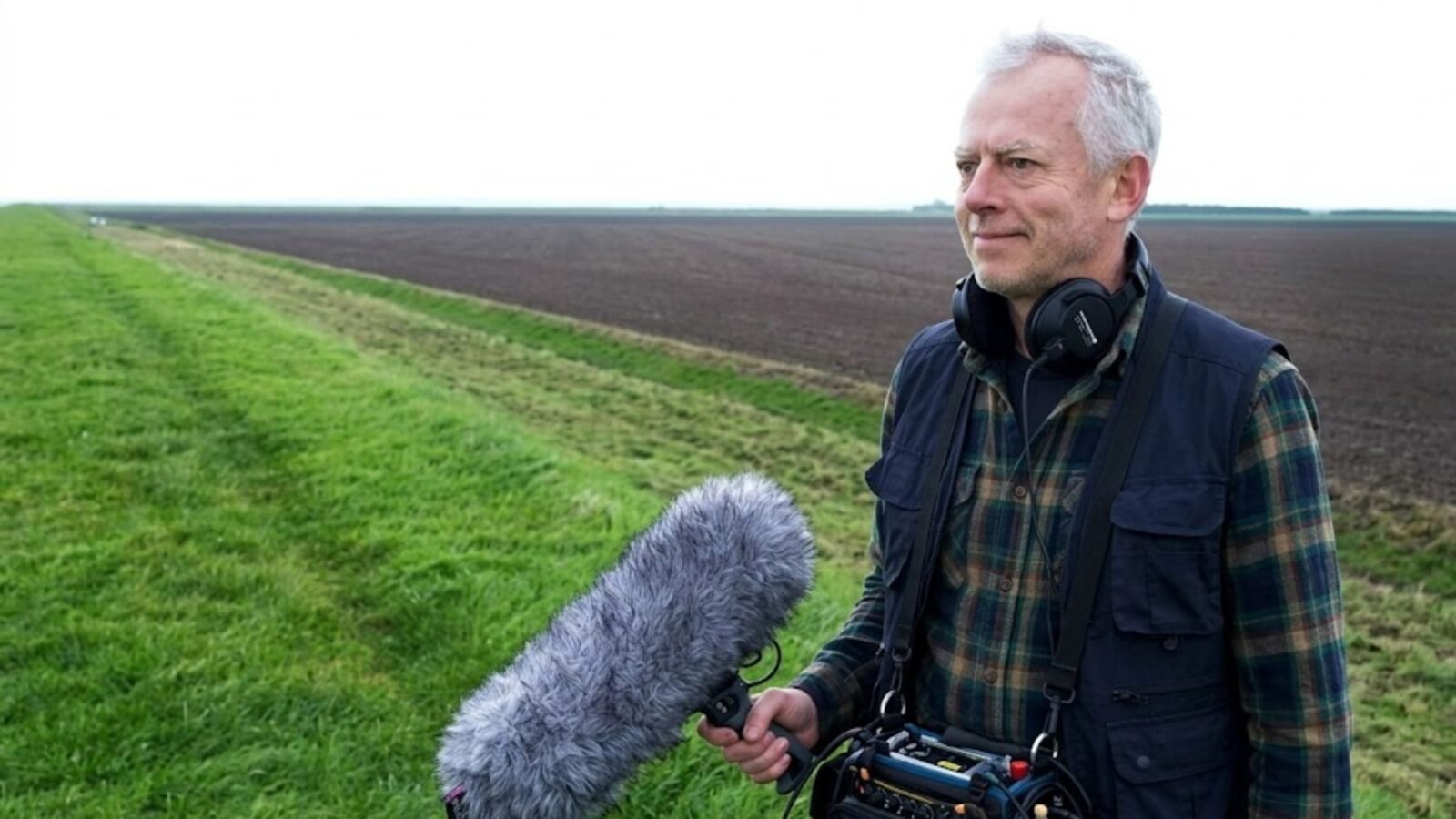

Long before Joe Alwyn entered Hollywood, Richard Alwyn was filming human stories in crisis zones, winning major documentary recognition and shaping the next generation of nonfiction filmmakers.
Richard Alwyn is frequently introduced with four words: Joe Alwyn’s father. That description is accurate, but it obscures the more substantial story. Richard built his own career across BBC and Channel 4 documentary production, directed an award-winning investigation of the Beslan school siege and later moved into documentary-film education at University College London.
His work has taken him from intimate studies of faith and language loss to politically charged stories involving Rwanda and Russia. The common thread is not celebrity or spectacle. It is close observation of ordinary people confronting events that alter their identities, beliefs or capacity to communicate.
Richard also belongs to a British creative family extending across four generations: composer William Alwyn, television director and producer Jonathan Alwyn, documentary filmmaker Richard Alwyn and actor Joe Alwyn. That lineage explains part of the renewed interest in him—but his professional record stands independently of the family name.
Richard Alwyn is a documentary filmmaker, writer and Associate Professor in Documentary Film at University College London. He is Joe Alwyn’s father, Jonathan Alwyn’s son and composer William Alwyn’s grandson. His best-documented achievement is directing The Beslan Siege, which won a Prix Italia in 2006.
Richard Alwyn at a Glance
| Detail | Verified information |
|---|---|
| Full name | Richard Alwyn |
| Profession | Documentary director, producer, writer and university educator |
| Current academic role | Associate Professor in Documentary Film at University College London |
| Known for | The Beslan Siege, The Shrine, Speechless, Catholics, Cathedrals and story work on Shooting Dogs |
| Major award | Prix Italia for The Beslan Siege in 2006 |
| Father | Jonathan Alwyn, television director and producer |
| Grandfather | William Alwyn, composer, conductor and former Royal Academy of Music professor |
| Partner or spouse | Publicly associated with psychotherapist Elizabeth Alwyn |
| Children | Thomas Alwyn, Joe Alwyn and Patrick Alwyn |
| Birth date | Not disclosed by an authoritative public source reviewed for this profile |
| Verified net worth | No reliable public valuation is available |
UCL currently identifies Richard as an Associate Professor in Documentary Film and a course leader within its Ethnographic and Documentary Film programme.
The Alwyn Name Was Established in Music Before It Reached Film
Richard Alwyn’s ancestry places him within a documented British creative lineage, although several online biographies confuse the generations.
His father, Jonathan Alwyn, worked as a television director and producer. Jonathan is associated with British television productions including Mystery and Imagination and is publicly identified as Richard’s father and Joe Alwyn’s grandfather.
Richard’s grandfather was William Alwyn, born in Northampton on 7 November 1905. William entered the Royal Academy of Music at 15 and became Professor of Composition there at 21, retaining the position for almost three decades. He composed concert music, symphonies and numerous film scores before his death in Suffolk on 11 September 1985.
The documented family sequence is therefore:
- William Alwyn — composer, conductor, flautist and music educator
- Jonathan Alwyn — television director and producer
- Richard Alwyn — documentary filmmaker, writer and educator
- Joe Alwyn — actor and songwriter
This sequence matters because Joe’s eventual career in film did not emerge from an unfamiliar environment. Moving-image production was already part of the family’s professional history through Jonathan and Richard, while William supplied an earlier connection to cinema through film composition.
Public sources provide little dependable information about Richard’s mother, siblings or childhood household. Claims that go further than the documented paternal lineage should therefore be treated cautiously.
From Teaching at the Sorbonne to Entering the BBC
Richard Alwyn’s precise date of birth, schools and university qualifications have not been disclosed in an authoritative public biography.
What is documented is a significant early transition. According to UCL, Richard taught English at the Sorbonne in Paris before joining the BBC. The university does not identify the exact Sorbonne institution, his teaching dates or the academic qualifications that preceded the appointment, so presenting a specific degree would be speculative.
After entering the BBC, he developed a practice centred on observational documentary. UCL describes his speciality as intimate portraits of ordinary people experiencing difficult periods in their lives. His programmes were subsequently produced for major BBC strands and Channel 4 and distributed internationally.
That professional method also explains the way Joe Alwyn describes his father’s work:
Richard makes “fly-on-the-wall, observational human stories.”
Joe recalled receiving stacks of films on VHS for birthdays and Christmas, while Richard’s assignments regularly took him away from home to distant locations. Those films and conversations appear to have given Joe an early practical education in cinema rather than merely exposing him to celebrity culture.
Richard’s role eventually expanded from making documentaries to teaching their underlying craft. At UCL, he has been involved in training students in observational filming, sound recording, editing, directing and the construction of nonfiction narratives from unscripted material.
A Verified Richard Alwyn Career Timeline
| Year | Project or milestone | Richard Alwyn’s involvement |
|---|---|---|
| 1997 | The Shrine | Directed a film examining the public mourning that followed the death of Diana, Princess of Wales. |
| 2002 | Stopping Distance | Made his first BBC fiction film; UCL identifies it as BAFTA-nominated. |
| 2005 | Shooting Dogs | Co-created the story with David Belton for the Rwanda genocide drama starring John Hurt and Hugh Dancy. |
| 2005 | The Beslan Siege | Directed the feature-length documentary about the 2004 school hostage crisis in Beslan, North Ossetia. |
| 2006 | Prix Italia | The Beslan Siege won the television current-affairs documentary prize. |
| 2006 | Samuel Johnson: The Dictionary Man | Directed the BBC drama-documentary about Samuel Johnson’s dictionary project. |
| 2012 | Catholics | Produced an observational BBC Four trilogy examining Catholic men, women and children. |
| 2013 | Cathedrals | Produced, filmed and directed three films set inside Wakefield, Wells and Southwark cathedrals. |
| 2017 | Into the Wind | Directed a BBC Four film following writer and broadcaster Tim Dee through the Lincolnshire Wash. |
| 2017 | Speechless | Directed a 60-minute BBC Four documentary about aphasia and stroke recovery. |
| Current public listing | University College London | Listed as Associate Professor in Documentary Film and an MA course leader. |
The Films That Define Richard Alwyn’s Method
The Shrine Recorded a Nation in Mourning
Following the death of Diana, Princess of Wales, in August 1997, Britain experienced an extraordinary period of public grief. Richard responded by documenting the crowds, flowers and collective silence around the royal parks.
Rather than reducing the response to either national unity or mass hysteria, The Shrine examined the behaviour itself. Contemporary coverage described Richard as determined to record the atmosphere in Hyde Park while the emotional reaction was still unfolding.
The subject suited the observational method that would recur across his later work: people gathering in a recognisable public space while confronting an event for which established rituals felt insufficient.
The Beslan Siege Brought International Recognition
Richard’s most consequential documented award came from The Beslan Siege, a feature-length documentary about the September 2004 hostage crisis at School Number One in Beslan.
The film included testimony from adult and child survivors and examined why the siege ended with such devastating loss of life. Rather than concentrating exclusively on geopolitical analysis, it reconstructed the event through those directly affected and through officials involved in the response.
In 2006, the documentary received the Prix Italia’s current-affairs television documentary award. The official historical winners register identifies Discovery Networks Europe as the submitting organisation and credits Richard for direction and script.
The award is important because it establishes an independently verifiable measure of professional recognition. Richard is not simply described as an “award-winning filmmaker” through circular celebrity biographies; the title is supported by the official Prix Italia record.
Shooting Dogs Moved His Work Into Feature Drama
Richard also contributed to Shooting Dogs, released in the United States as Beyond the Gates. Directed by Michael Caton-Jones, the 2005 film dramatized events surrounding the Rwandan genocide at the École Technique Officielle in Kigali.
The credited story originated with Richard and BBC producer David Belton, whose experiences in Rwanda informed the production. John Hurt played a Catholic priest, while Hugh Dancy portrayed an English teacher caught inside the school compound as United Nations forces prepared to withdraw.
Richard did not direct the finished feature. His documented credit is for the story. This distinction matters because numerous derivative biographies inaccurately describe every project associated with him as a directing assignment.
Catholics and Cathedrals Turned Institutions Into Human Studies
The three-part Catholics series examined British Catholic identity through men preparing for the priesthood, children in Catholic education and women connected with Westminster Cathedral.
The series did not function primarily as theological instruction. Its central question was how institutional belief shapes everyday conduct, responsibility and personal identity. The Westminster episode, for example, followed staff, volunteers and congregants rather than using prominent public figures to explain Catholicism from above.
A year later, Cathedrals applied a related method to three Church of England institutions: Wakefield, Wells and Southwark. Richard produced, filmed and directed the trilogy, observing how the buildings operated as workplaces, sacred spaces, community centres and historical structures in an increasingly secular society.
Speechless Made Language Loss Personal
Speechless originated partly from Richard’s experience of aphasia within his extended family. His brother-in-law, journalist Dennis Barker, had a stroke in 2011 that severely disrupted his ability to use meaningful language.
The documentary followed former professional footballer Junior Agogo and another stroke survivor, Barry, as they underwent treatment and attempted to rebuild communication. Much of the programme was filmed at the National Hospital for Neurology and Neurosurgery in Queen Square, London. It was broadcast on BBC Four on 29 October 2017, World Stroke Day.
The film extended beyond clinical explanation. It asked what happens to identity, thought and social relationships when a person understands the world but can no longer reliably express that understanding through speech.
Inside the Alwyn Household That Produced Three Sons
Richard and psychotherapist Elizabeth Alwyn, also identified in some publications as Elizabeth Meakins, are the parents of three sons:
- Thomas Alwyn, the eldest
- Joe Alwyn, born on 21 February 1991
- Patrick Alwyn, the youngest
Joe was born in Tunbridge Wells, Kent, and raised in North London. Public interviews indicate that Thomas is approximately 18 months older than Joe, while Patrick was born when Joe was around 12.
Richard’s filming assignments sometimes took him to countries experiencing conflict or political instability, including Uganda and Rwanda. Joe has described his father being absent for periods while working in distant locations but returning with gifts and stories from those assignments.
The influence appears to have continued into Joe’s professional adulthood. In a 2024 interview, Joe said Richard and Elizabeth sometimes read scripts he was considering and that he valued their opinions. The detail indicates an ongoing advisory relationship grounded in Richard’s production experience and Elizabeth’s understanding of people and behaviour.
It would nevertheless be an overstatement to attribute Joe’s career solely to family access. Joe studied English literature and drama at the University of Bristol, trained at the Royal Central School of Speech and Drama and secured his breakout role in Ang Lee’s Billy Lynn’s Long Halftime Walk through the professional casting process. Richard supplied cultural exposure and informed guidance, not a documented direct appointment into the role.
Richard Alwyn’s Financial Position Cannot Be Responsibly Valued
No authoritative source publishes Richard Alwyn’s salary, investment holdings, property portfolio or total assets. Consequently, websites assigning him a precise net worth are presenting estimates without a transparent evidentiary basis.
His publicly identifiable professional income channels include:
| Potential income source | What can be verified |
|---|---|
| Documentary directing and production | Richard has directed and produced programmes for BBC, BBC Four, Channel 4 and independent production companies. |
| Writing and story development | He received a story credit on Shooting Dogs and writing-related credits on other productions. |
| University employment | UCL lists him as an Associate Professor in Documentary Film. |
| Residuals or licensing | Possible for some film and television professionals, but no individual figures are publicly available. |
| Private companies or investments | No reliable valuation was located in the authoritative sources reviewed. |
A credible Richard Alwyn net-worth figure therefore does not exist in the public record. The correct answer is undisclosed, not an invented range derived from his son’s profile or from assumptions about BBC production fees.
This distinction is particularly important because family wealth is often conflated online. Joe Alwyn’s acting and songwriting income does not establish Richard’s personal assets, just as William Alwyn’s musical legacy does not provide a present-day valuation of his descendants.
Frequently Asked Questions About Richard Alwyn
Who is Richard Alwyn?
Richard Alwyn is a documentary filmmaker, writer and Associate Professor in Documentary Film at University College London. He has made programmes for the BBC and Channel 4 and is best known for directing The Beslan Siege. He is also the father of English actor Joe Alwyn.
What does Joe Alwyn’s father do?
Joe Alwyn’s father works in documentary filmmaking and higher education. Richard has directed observational documentaries, contributed to feature-film story development and taught practical nonfiction filmmaking. UCL currently lists him as an Associate Professor and course leader connected with its Ethnographic and Documentary Film MA.
What award did Richard Alwyn win?
Richard Alwyn won a Prix Italia in 2006 for directing and scripting The Beslan Siege. The documentary examined the 2004 hostage crisis at a school in Beslan through survivor testimony and evidence concerning the authorities’ response. The Prix Italia’s official historical register confirms the award.
Is Richard Alwyn related to composer William Alwyn?
Richard Alwyn is William Alwyn’s grandson. William was a British composer, conductor, flautist and former Professor of Composition at the Royal Academy of Music. Richard’s father, television director and producer Jonathan Alwyn, was William’s son. Joe Alwyn is therefore William Alwyn’s great-grandson.
Who are Richard Alwyn’s wife and children?
Richard is publicly associated with psychotherapist Elizabeth Alwyn, also known professionally as Elizabeth Meakins. They are identified as the parents of Thomas, Joe and Patrick Alwyn. The family has maintained a comparatively private life despite the attention surrounding Joe’s acting career.
What is Richard Alwyn’s net worth?
Richard Alwyn’s net worth is not publicly verified. No authoritative disclosure provides his salary, property ownership, investments or total assets. Estimates circulating on biography and celebrity-finance websites should not be treated as factual unless they are supported by audited accounts, official filings or attributable financial reporting.
The Legacy Is in the Way He Observes People
Richard Alwyn’s significance does not depend on his proximity to a famous son.
His record includes a major international documentary award, work across British public-service broadcasting, feature-film story development and a senior role teaching nonfiction filmmakers. The subjects differ—national mourning, genocide, religion, cathedrals, weather and aphasia—but the governing method remains consistent.
Richard watches before he explains. He places people rather than celebrity personalities at the centre of the frame. He allows institutions to be understood through those living and working inside them. That method also clarifies the creative inheritance visible in Joe Alwyn’s restrained public persona and preference for character-led films.
Joe may now be the most internationally recognised Alwyn. Richard, however, represents the less visible link between the family’s musical past and its contemporary screen work.
Sources and Verification
- University College London — Documentary Film Tutors — Official professional biography, teaching role, major productions and Prix Italia recognition.
- Prix Italia Historical Winners Register — Official confirmation of The Beslan Siege award and production credits.
- UCL Brain Sciences — Speechless — Documentary context, production history and Richard’s comments about aphasia.
- Wellcome Collection — Speechless Catalogue Record — Runtime, broadcast date, production credits and clinical setting.
- Wingspan Productions — Cathedrals — Series locations and Richard’s producer, camera and director credits.
- The Guardian — Joe Alwyn Interview — Joe’s account of Richard’s filmmaking method and influence on his interest in cinema.
- Faber Music — William Alwyn — Authoritative biography of Richard’s grandfather and his musical career.
Editorial Disclaimer: This profile distinguishes documented facts from unsupported online claims. Richard Alwyn’s birth date, complete educational history, private financial information and net worth have not been confirmed by authoritative public records. Details may be updated when dependable primary evidence becomes available.
