
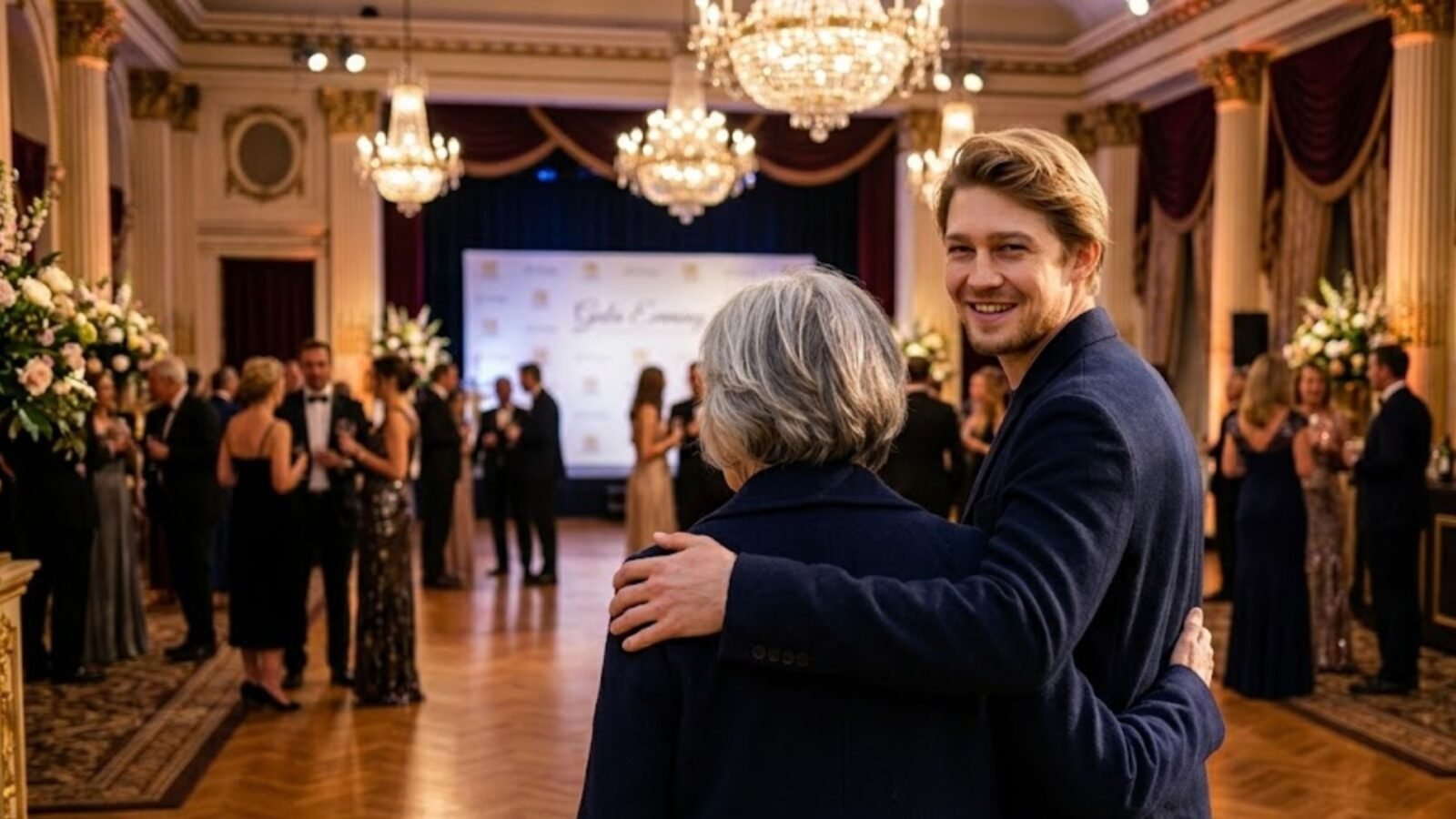

Known publicly as Joe Alwyn’s mother, Elizabeth Alwyn built a substantial career in psychotherapy and mental-health writing long before celebrity interest reached her family.
Searches for Elizabeth Alwyn often begin with her connection to British actor Joe Alwyn. That framing, however, captures only a fraction of her public record.
Under the professional name Elizabeth Meakins, she has worked across occupational therapy, psychoanalysis, private clinical practice and mental-health journalism. Her published work addresses anxiety, relationships, trauma, grief and the uncertain, collaborative nature of psychotherapy.
Her family entered a far brighter spotlight when Joe Alwyn became an internationally recognised actor and later attracted intense attention through his relationship with Taylor Swift. Elizabeth largely resisted that attention, remaining a clinician and writer rather than becoming a public celebrity herself.
Elizabeth Alwyn, professionally known as Elizabeth Meakins, is a North London psychoanalytic psychotherapist, former senior occupational therapist and mental-health writer. She and documentary filmmaker Richard Alwyn have three sons—Thomas, actor Joe Alwyn and Patrick—while most details concerning her age, education, finances and private life remain undisclosed.
Elizabeth Alwyn at a Glance
| Detail | Verified information |
|---|---|
| Publicly used name | Elizabeth Alwyn |
| Professional and publishing name | Elizabeth Meakins |
| Profession | Psychoanalytic psychotherapist and writer |
| Earlier work | Senior occupational therapist in community mental-health services |
| Clinical base | North London |
| Professional qualification | Psychoanalyst/psychoanalytic psychotherapist qualification recorded in 1994 |
| Partner or husband | Documentary filmmaker Richard Alwyn |
| Children | Thomas Alwyn, Joe Alwyn and Patrick Alwyn |
| Known book | What Will You Do With My Story? |
| Birth date and age | Not authoritatively published |
| Verified net worth | No reliable figure is available |
The clinical information is documented by Bupa and the UK Council for Psychotherapy, while the family details have been reported by People and confirmed indirectly through Joe Alwyn’s interviews about his parents.
Elizabeth Alwyn or Elizabeth Meakins? Understanding the Two Names
Mainstream entertainment profiles generally refer to Joe Alwyn’s mother as Elizabeth Alwyn, using the family surname shared by Joe, Richard, Thomas and Patrick. Her clinical directory entries, newspaper columns and published book instead appear under Elizabeth Meakins.
Several reports explicitly identify Joe Alwyn’s mother as Elizabeth Meakins, linking the professional name with the person otherwise described as Elizabeth Alwyn. The available sources therefore strongly support that these names refer to the same individual, although no civil marriage certificate or formal name-change document was used for this profile.
This distinction matters because searches limited to “Elizabeth Alwyn” can miss most of her professional record. Her work as a therapist, columnist and author is principally indexed under Elizabeth Meakins.
It also explains why brief celebrity biographies sometimes describe her only as a psychotherapist without mentioning her writing, clinical specialisms or professional history.
Before Psychoanalysis: Work Inside Mental-Health Services
Elizabeth’s professional biography indicates that she did not enter psychotherapy directly through private practice.
Before qualifying as a psychoanalyst, she worked in:
- Psychiatric day hospitals
- Long-stay care
- A community mental-health team
- A senior occupational-therapy position
These settings would have involved working with people experiencing persistent, complex or crisis-related psychological difficulties rather than only providing short-term private counselling.
Her Bupa profile records a psychoanalyst and psychoanalytic-psychotherapist qualification from the Guild of Psychoanalytic Psychotherapists in 1994. The UK Council for Psychotherapy subsequently listed her as a psychoanalytic psychotherapist practising in North London.
The publicly available directories do not identify her undergraduate institution, occupational-therapy training provider or school. Claims assigning her a particular university degree, birth year or educational history should therefore be treated as unverified unless supported by a professional register or a direct statement from Elizabeth.
Her Recorded Areas of Clinical Work
Bupa’s directory lists Elizabeth’s areas of interest as including:
- Individual therapy
- Couples therapy
- Anxiety disorders
- Depression
- Eating disorders
- Relationship difficulties
- Work-related stress
- Bereavement
- Separation anxiety
- Midlife concerns
- Trauma
The directory also identifies short-term psychodynamic therapy among her professional specialisms.
Psychodynamic and psychoanalytic therapies generally examine recurring emotional patterns, relationships, defences and unconscious processes. Elizabeth’s own published description places particular emphasis on helping people understand why they are struggling and how they might challenge entrenched patterns rather than simply applying a predetermined formula.
The Therapist Who Took Psychological Questions Into Print
Elizabeth Meakins combined clinical work with an extensive writing career.
Her professional biography records years of freelance features, magazine articles and advice columns. It also notes that she wrote agony-aunt material for Marie Claire and Sainsbury’s publications.
Her most visible body of journalism appeared in The Independent, where she wrote columns associated with “Tales From the Therapist’s Couch.” The newspaper’s author archive contains articles addressing parental pressure, anxiety, personal boundaries, family relationships, emotional conflict and the experience of therapy.
Rather than presenting psychotherapy as a clinician delivering instant solutions, her writing treated it as a negotiated process shaped by uncertainty, trust, resistance and the individual patient’s account.
That editorial position became the foundation of her book.
What Will You Do With My Story?: Elizabeth Meakins as an Author
Elizabeth Meakins published What Will You Do With My Story? in 2012. Routledge lists the work as a 158-page examination of the therapeutic process based partly on her popular columns from The Independent.
The book’s central argument is that effective analysis cannot be reduced to rigid adherence to a preselected theory. The therapist must remain responsive to what is occurring between therapist and patient, including ambiguity, discomfort and developments that challenge the practitioner’s original interpretation.
Its chapter structure includes discussions of:
- Doubt and certainty
- The capacity to remain with uncertainty
- Secrets and silence
- The search for other people
- Social expectations placed on women
- Multiple dimensions of personal identity
The book also examines the ethical question contained in its title: what responsibility does a therapist acquire when another person entrusts them with painful, intimate or traumatic material?
A 2012 review in The Guardian highlighted the book’s candid presentation of clinical frustration and its willingness to draw from several therapeutic traditions rather than defend a narrow doctrinal position.
The publication establishes Elizabeth as more than a relative of a well-known actor. It documents an independent professional identity built around clinical practice, public communication and sustained consideration of therapeutic ethics.
A North London Household Shaped by Film and Human Behaviour
Elizabeth and documentary filmmaker Richard Alwyn raised three sons: Thomas, Joe and Patrick. Joe, born on February 21, 1991, is the middle child; Thomas is older, while Patrick was born when Joe was attending secondary school.
The family lived in North London, with Joe later describing an upbringing connected to Kentish Town and the surrounding area. Richard’s documentary work took him abroad, including assignments in crisis-affected locations, while Elizabeth’s profession focused on psychological experience and interpersonal behaviour.
Joe has explicitly connected his parents’ professions with his own work as an actor:
“Both their jobs have a heavy interest in why people are the way they are.”
That observation offers the strongest evidence of Elizabeth’s influence on her son. Acting, documentary filmmaking and psychotherapy all depend, in different ways, on observing motivation, contradiction, emotion and behaviour.
Joe has also said that having a therapist as a mother did not mean being continuously analysed at home. Instead, he described Elizabeth as someone who is good with people, easy to talk to and engaged in work he considers valuable. He has suggested that psychotherapy might have interested him as an alternative career.
Three Sons, Three Different Levels of Public Exposure
Thomas Alwyn, the eldest son, has reportedly worked in the non-governmental sector and remains largely outside entertainment coverage.
Joe became an actor after studying English and drama at the University of Bristol and training at the Royal Central School of Speech and Drama. His screen career began with the leading role in Ang Lee’s Billy Lynn’s Long Halftime Walk.
Patrick, considerably younger than Joe, has occasionally appeared in celebrity reporting but maintains a predominantly private life.
Elizabeth and Richard have therefore maintained a relatively conventional family structure despite the extraordinary scrutiny surrounding one of their sons.
The Meakins Family Connection and a Tradition of Public Service
A 2011 family death notice for Dick Meakins identified Rosemary as his wife and named David, Catherine, Elizabeth and Peter as their children. It also listed grandchildren including Tom, Joe and Patrick, creating a persuasive public link between Elizabeth Meakins and the Alwyn family.
The same family line connects Elizabeth to the late British peace campaigner Bruce Kent.
The Guardian and the Catholic Bishops’ Conference of England and Wales reported that Kent was survived by his sister Rosemary Meakins. When read alongside the Meakins family notice, the evidence indicates that Bruce Kent was Elizabeth’s maternal uncle and Joe Alwyn’s great-uncle. This relationship is an inference produced by combining the two family records, rather than a complete published genealogy.
Kent was a former Catholic priest and a prominent advocate for nuclear disarmament and peace campaigning. The connection adds another dimension to the family’s public record: documentary work, psychotherapy, humanitarian or NGO employment, acting and peace activism all appear across different branches and generations.
Authoritative sources do not establish the professions of both of Elizabeth’s parents, her complete ancestry or the details of her childhood. More elaborate genealogical claims found on unsourced celebrity websites should not be treated as established facts.
A Public Timeline Built From Professional Records
| Period | Documented development |
|---|---|
| Before 1994 | Worked in psychiatric day hospitals, long-stay care and community mental-health services |
| 1991 | Her son Joe Alwyn was born on February 21 |
| 1994 | Qualified as a psychoanalyst/psychoanalytic psychotherapist |
| Subsequent years | Developed a North London private practice and wrote mental-health columns and features |
| 2012 | Published What Will You Do With My Story? |
| 2021 | Was photographed on a rare public walk in North London with Joe Alwyn and Taylor Swift |
| 2024 | Mainstream profiles renewed attention around Richard and Elizabeth Alwyn as Joe’s parents |
| 2025 | Joe again discussed the influence of his parents’ psychologically observant professions |
| 2026 | Professional directories continued to carry an Elizabeth Meakins psychotherapy profile |
The Missing Figures: Age, Salary, Assets and Net Worth
There is no authoritative public record establishing Elizabeth Alwyn’s date of birth, current age, annual income, property portfolio or personal net worth.
Celebrity-biography websites may publish numerical estimates, but those figures generally lack tax filings, company accounts, court disclosures, property records or direct financial statements. They should not be repeated as verified information.
Private psychotherapists can earn income through clinical sessions, writing, consulting, supervision and other professional activities. That general business model does not provide a defensible basis for calculating Elizabeth’s wealth.
Her husband and son have careers in film, but family relationships do not establish ownership of another person’s income or assets. The only responsible assessment is therefore that Elizabeth Alwyn’s net worth remains undisclosed and cannot be reliably estimated from the available evidence.
Privacy Is Not an Information Gap to Be Filled With Speculation
Elizabeth’s limited media presence appears consistent with the wider Alwyn family’s approach to public exposure.
Joe has repeatedly discussed the value he places on privacy, family and long-standing friendships. Even during years of intense international attention, his parents rarely gave interviews about his career or relationships.
Elizabeth’s professional work also creates an additional reason for discretion. Psychotherapists operate within strong ethical expectations concerning confidentiality, boundaries and the protection of patient information. A clinician may write about therapeutic principles or anonymised experiences without turning their own household into public material.
Her relative absence from celebrity media should consequently be understood as a boundary, not evidence that unsupported claims are needed to complete her biography.
Frequently Asked Questions About Elizabeth Alwyn
Who is Elizabeth Alwyn?
Elizabeth Alwyn is the mother of British actor Joe Alwyn and the partner or wife of documentary filmmaker Richard Alwyn. She is professionally known as Elizabeth Meakins and has worked as a psychoanalytic psychotherapist, occupational therapist, columnist and author in North London.
Is Elizabeth Alwyn the same person as Elizabeth Meakins?
Elizabeth Alwyn and Elizabeth Meakins are widely reported as the same person. Celebrity profiles use the Alwyn family surname, while psychotherapy registers, newspaper archives and her book use Elizabeth Meakins. The professional and family records align closely, although a formal public name-change document has not been cited.
What does Joe Alwyn’s mother do?
Joe Alwyn’s mother is a psychoanalytic psychotherapist. Her professional record also documents previous work in psychiatric hospitals, long-stay care and a community mental-health team, where she served as a senior occupational therapist. Her clinical interests include anxiety, depression, trauma, bereavement and relationship problems.
Did Elizabeth Alwyn write a book?
Elizabeth Meakins wrote What Will You Do With My Story?, first published in 2012. The book uses material developed through her Independent columns to examine uncertainty, ethics, theory and collaboration within psychoanalytic treatment.
How many children does Elizabeth Alwyn have?
Elizabeth and Richard Alwyn have three sons: Thomas, Joe and Patrick. Thomas is older than Joe, while Patrick was born when Joe was in secondary school. Joe is the only sibling with a major public acting career.
What is Elizabeth Alwyn’s net worth?
Elizabeth Alwyn’s net worth is not publicly verified. No authoritative financial filing, asset declaration or direct statement provides a reliable figure. Online estimates that assign her a precise fortune should be treated as speculation rather than documented financial information.
The Identity That Exists Beyond “Joe Alwyn’s Mother”
Elizabeth Alwyn’s connection to Joe Alwyn explains the public curiosity surrounding her, but it does not define the full record.
As Elizabeth Meakins, she spent years working inside mental-health services before qualifying in psychoanalytic psychotherapy. She established a clinical practice, wrote extensively about emotional difficulties and produced a serious book about what happens when one person entrusts another with their private history.
Her influence on Joe is visible not through dramatic family revelations but through his language about empathy, motivation and the need to understand why people behave as they do. Those are core questions in psychotherapy, documentary filmmaking and acting alike.
The verified portrait is therefore quieter and more substantive than celebrity coverage suggests: Elizabeth Alwyn is a clinician and writer whose professional work predates her son’s fame and remains the most meaningful public evidence of who she is.
Sources and Verification
- UK Council for Psychotherapy therapist register — professional modality and North London registration.
- Bupa Finder professional profile — career history, qualification, clinical interests and publications.
- Routledge: What Will You Do With My Story? — publication date, length, synopsis and chapter structure.
- The Independent author archive — archived mental-health columns written under Elizabeth Meakins.
- The Guardian interview with Joe Alwyn — Joe’s description of his parents’ professions and influence.
- People profile of Richard and Elizabeth Alwyn — family structure and Joe’s comments about his mother’s work.
Editorial Disclaimer: This profile distinguishes documented information from inference and unsupported celebrity reporting. Personal details, financial estimates and family claims without reliable public evidence have been excluded or explicitly identified as unverified. Professional-directory information may change and should be confirmed directly with the relevant regulatory or clinical organisation.
