
France Blames Iran for Supermarket Fridge Cyberattack: The ‘Unprecedented’ Sabotage — What We Know So Far
It is the strangest act of sabotage France has ever blamed on a foreign state: hackers breaking into supermarket refrigerators, switching on their defrost cycles overnight, and letting temperatures climb until the food inside spoiled. On Monday, 9 November 2026, France said it knows who did it. Foreign Minister Jean-Noël Barrot stood before reporters and pointed the finger directly at Iran’s Revolutionary Guard, calling the attack “unprecedented in both its scale and its level of aggression” and vowing European sanctions in response.
BLUF: France has formally accused Iran’s Islamic Revolutionary Guard Corps (IRGC) of carrying out a cyberattack on 11 and 12 October 2026 that disabled refrigeration systems in around 700 supermarkets across France, spoiling vast quantities of food and in some cases starting fires. Paris has summoned Iran’s ambassador, opened a formal judicial investigation into the IRGC-linked cyber unit Shahid Kaveh, and said it will seek sanctions at European level. Tehran has not commented on the allegations.
At a Glance
- The accusation: On Monday, 9 November 2026, French Foreign Minister Jean-Noël Barrot said: “I can confirm that this attack was carried out by the Islamic Revolutionary Guard Corps of the Islamic Republic of Iran.”
- What happened: On 11 and 12 October 2026, hackers remotely accessed supermarket refrigeration systems and forced temperatures up to 50°C (122°F) overnight, spoiling food and causing fires in some stores.
- The scale: Around 700 of France’s roughly 10,000 supermarkets were hit, including E.Leclerc, Intermarché, Carrefour, Monoprix and Cooperative U stores.
- The evidence cited: France’s cybersecurity agency ANSSI attributed the attack to Shahid Kaveh, an IRGC cyber unit, citing Farsi language in the attack infrastructure and IP addresses pointing to devices in Iran.
- The legal response: The Paris prosecutor’s office has opened a formal judicial investigation and requested international arrest warrants for the head of Shahid Kaveh and his two deputies.
- The diplomatic response: Iran’s ambassador to France has been summoned, and France says it will push for sanctions “at a European level” against those responsible.
- Tehran’s position: There was no immediate comment from Iran on the French allegations.
- The wider picture: Similar attacks on supermarket freezers were reported in Sweden, Belgium, Ireland and other European countries in early November, though French officials have not said the incidents are linked.
How the fridges were hacked
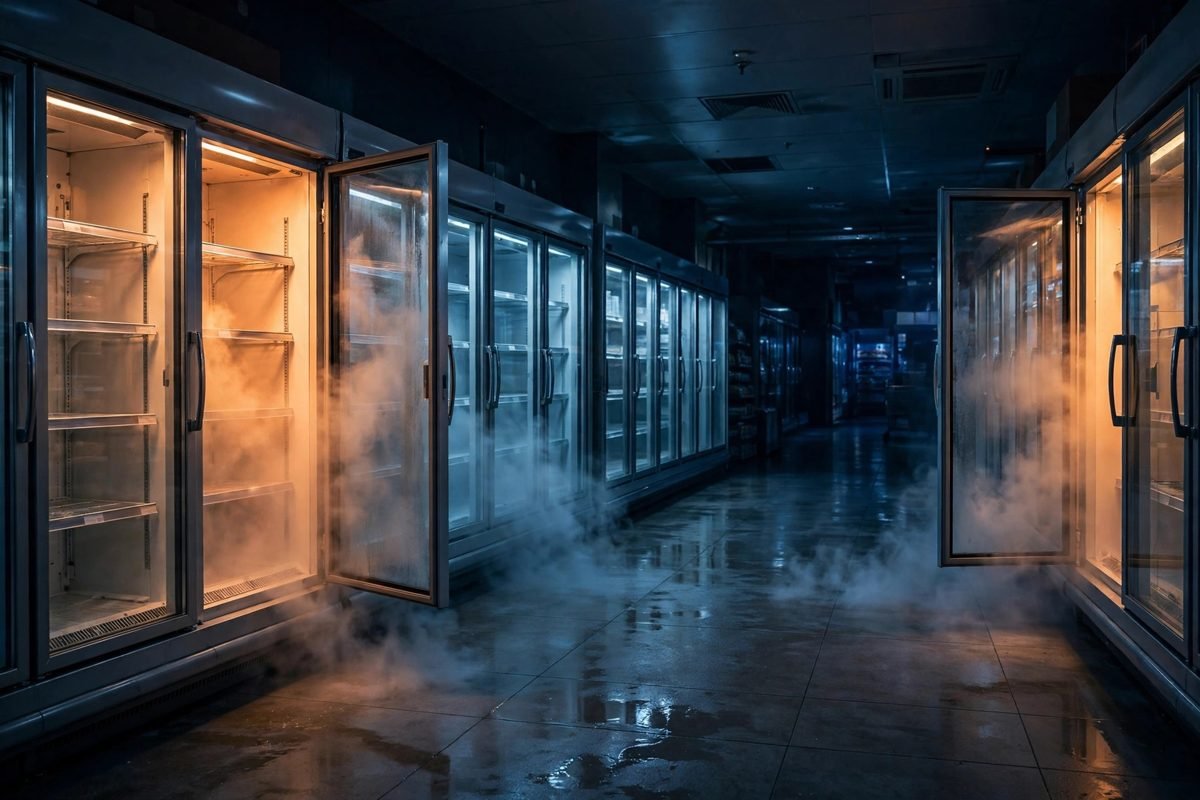
The attack was, in technical terms, almost absurdly simple — and that is what makes it alarming. According to French investigators, the hackers gained internet access to the commercial refrigeration systems used by supermarkets and remotely triggered their defrost cycles, overriding the temperature controls. Overnight, while the stores were closed, the temperature inside the fridges and freezers climbed as high as 50 degrees Celsius.
By morning, staff arrived to find spoiled produce, ruined frozen stock and, in some cases, fires. Photographs from the aftermath showed boxes of spoiled food piled outside an Intermarché supermarket in Paris on 13 October. The systems ran on software supplied by the Danish engineering company Danfoss, which lets supermarket operators manage refrigeration units remotely — the same connectivity that makes the systems efficient also made them reachable.
Why France is pointing at Iran
France’s attribution rests on the work of ANSSI, the national cybersecurity agency, working with French intelligence services. In a statement, ANSSI said it was able to attribute the attacks to Shahid Kaveh, described as a cyber-offensive unit affiliated with the Electronic and Cyber Centre of the Islamic Revolutionary Guard Corps (IRGC-ECC). The evidence cited includes the use of Farsi in the attack infrastructure, IP addresses pointing to devices located in Iran, and the relay of the attack by a propaganda outlet linked to the group.
The Paris prosecutor, Laure Beccuau, said a formal judicial investigation had been opened on Monday into suspected organised cybercrime, with the aggravating circumstance of having been “committed to serve the interests of a foreign power — in this case, Iran”. Her office said it had requested international arrest warrants against the leader of Shahid Kaveh and his two deputies. Reuters reported that three alleged associates have been named: Hamid Reza Lashgarian, Mahdi Lashgarian and Reza Salarvand.
The group is not new to Western intelligence. Shahid Kaveh, which also calls itself CyberAv3ngers, was blamed by the UK government for an attack in July, and ANSSI said it has attributed other cyber operations against French interests since 2020 to a second IRGC-affiliated unit, Shahid Shoostari. On 5 November, the US Cybersecurity and Infrastructure Security Agency, the FBI and other American agencies published a fact sheet on the same kind of refrigeration-system attacks.
It is worth being precise about what has and has not been proved in public. France has published its attribution and described the technical evidence behind it, but the full intelligence has not been made public, and Iran has not responded to the allegations. The claims should be reported as France’s official position, not as independently verified fact.
France’s response: ambassador summoned, sanctions promised
The diplomatic fallout was immediate. Barrot said Iran’s ambassador had been summoned to the French foreign ministry to “strongly protest against this extremely serious act”, speaking on the sidelines of G7 talks in Paris. “We will impose sanctions at the European level against all those responsible for this attack,” he added, vowing to take “any other measures needed” to respond and deter future attacks.
The French foreign ministry condemned the attack “in the strongest possible terms”. The speed of the response — attribution, judicial investigation, ambassador summoned and sanctions promised all on the same day — signals how seriously Paris is treating an attack that, for all its oddity, struck at food supplies and public safety rather than at data or money. Barrot’s language — calling the attack a threat to “the security of the French people” — frames it not as a criminal hack but as an act by a foreign state against France itself.
Was France the only target?
Possibly not. Similar attacks on supermarket refrigeration were reported in Sweden, Belgium and Ireland earlier in November, and on 2 November supermarkets in at least nine other European countries reported suspected attacks on their freezer systems. Barrot spoke only about the French case, and French officials have not said the incidents are linked — but the pattern has raised questions across Europe about whether the same actors, or the same vulnerabilities, were involved.
The firm behind many of the affected units has said several were obsolete or running outdated firmware, which could have made them easier to break into. That detail matters: it suggests the attackers exploited known weaknesses in widely used industrial systems, the kind of infrastructure that sits in the background of everyday life and is rarely thought of as a target until it fails.
For now, the questions that remain are the ones France has not yet answered publicly: how much of the technical evidence will be shared with allies, whether European sanctions will follow, and whether Iran will respond at all. What is certain is that a cyberattack on supermarket fridges — once it would have sounded like a joke — is now the subject of a formal state accusation, a criminal investigation and a diplomatic row.
People Also Ask
What happened in the France supermarket fridge cyberattack?
On 11 and 12 October 2026, hackers remotely accessed the refrigeration systems of around 700 supermarkets across France, triggering defrost cycles that raised temperatures to as high as 50°C (122°F) overnight. The attack spoiled large quantities of food and caused fires in some stores, hitting chains including E.Leclerc, Intermarché, Carrefour, Monoprix and Cooperative U.
Who does France blame for the supermarket fridge hack?
France blames Iran’s Islamic Revolutionary Guard Corps. Foreign Minister Jean-Noël Barrot said on 9 November 2026: “I can confirm that this attack was carried out by the Islamic Revolutionary Guard Corps of the Islamic Republic of Iran.” France’s cybersecurity agency ANSSI attributed the attack to Shahid Kaveh, an IRGC-linked cyber unit, citing Farsi language in the attack infrastructure and IP addresses pointing to devices in Iran.
How many supermarkets were affected by the fridge cyberattack?
Around 700 of France’s roughly 10,000 supermarkets were hit, according to French officials and the Associated Press. Similar attacks on supermarket freezers were also reported in Sweden, Belgium, Ireland and other European countries in early November, though French officials have not confirmed the incidents are linked.
What is France doing in response to the fridge cyberattack?
France has summoned Iran’s ambassador, opened a formal judicial investigation into the IRGC-linked Shahid Kaveh unit, and requested international arrest warrants for the unit’s leader and his two deputies. Foreign Minister Jean-Noël Barrot said France will seek sanctions “at a European level” against all those responsible, and vowed to take “any other measures needed” to respond and deter future attacks.