

England School Phone Ban: Pupils Face Lockable Pouches and Full-Day Bans — What the New Rules Mean
For years, the compromise in England’s classrooms has been “not seen, not heard”: a phone could sit in a pupil’s bag all day, switched off and out of sight, and that counted as a ban. On Monday evening, the government said that compromise is over. Under strengthened statutory guidance, schools in England will be expected to make sure pupils cannot get at their phones at all during the school day — not in a bag, not in a pocket, not anywhere on their person.
BLUF: The Department for Education (DfE) announced on Monday, 9 November 2026, that strengthened statutory guidance will require schools in England to go beyond “not seen, not heard” phone policies and adopt whole-school strategies that keep phones out of use and inaccessible throughout the school day. Schools will be able to choose how to do it — lockable pouches, collecting phones at the start of the day, secure lockers, or banning phones from the site altogether — when the updated guidance comes into force from September 2027.
At a Glance
- What was announced: Strengthened DfE statutory guidance telling schools in England to move beyond “not seen, not heard” policies, where phones may remain in pupils’ bags.
- What changes: Phones must be out of use and inaccessible for the whole school day — not just during lessons, but at breaks and lunchtimes too.
- How schools can comply: Lockable pouches, phones collected on arrival, secure storage or lockers, or banning phones from the school site entirely. Schools choose the method.
- When it takes effect: The updated guidance comes into force from September 2027.
- Who announced it: Education Secretary Lucy Powell, who said: “Children should not be using smartphones at any point during the school day, full stop.”
- The funding question: The DfE announcement mentioned no additional funding for pouches or lockers, and teaching unions have warned that schools will need extra money to introduce more robust policies.
- The evidence cited: DfE polling found that only 16% of secondary pupils say phone rules are followed all of the time.
What the government actually announced
The announcement, published by the Department for Education on Monday evening, tightens guidance that already exists. Statutory guidance that came into force in June 2026 made schools and trusts legally responsible for being phone-free throughout the day, and the Children’s Wellbeing and Schools Act, which received Royal Assent on 29 April 2026, includes a duty for schools to restrict mobile phones. But the existing guidance left it to headteachers to decide how to achieve a phone-free day, and many schools settled on “not seen, not heard”, with phones switched off in bags.
The strengthened guidance, as described by the DfE, will make clear that schools should go beyond that approach and adopt whole-school strategies that keep phones out of use and inaccessible throughout the school day. In the department’s own words: “The strengthened guidance will make clear that schools should go beyond ‘not seen, not heard’ — where phones may remain in pupils’ bags — and adopt whole-school strategies that keep phones out of use and inaccessible throughout the school day.”
Education Secretary Lucy Powell was blunt about the intention. “Children should not be using smartphones at any point during the school day, full stop,” she said, adding that the aim is to create “truly phone-free schools” and distraction-free classrooms.
Lockable pouches, lockers or a full ban — schools choose
The guidance does not prescribe a single method; schools choose the approach that fits them, and the examples already in use across England show how varied that can be.
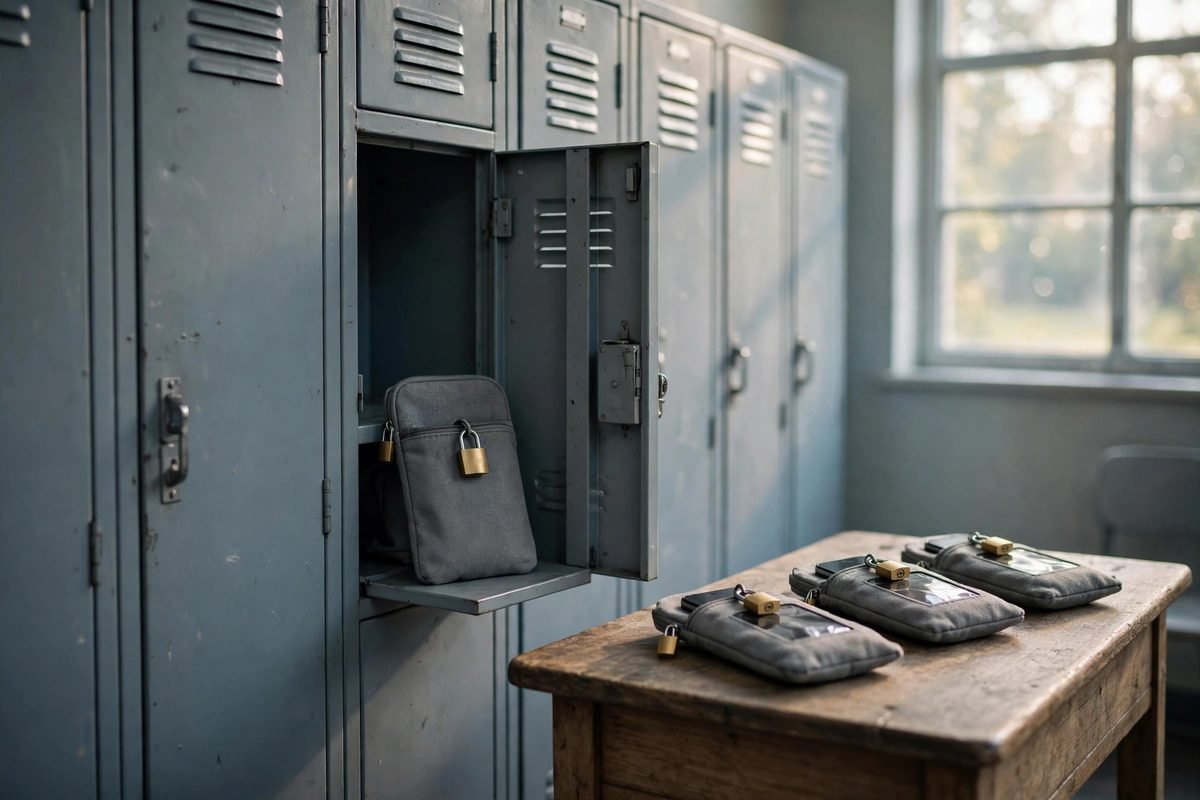
Some schools have invested in sealed, lockable pouches: pupils keep their own phone in a pouch that can only be unlocked by a magnet at the school gates when they leave. One secondary school in Hull uses exactly this system. Others collect phones at the start of the day and hand them back at home time, store them in secure phone lockers, or have prohibited phones from their sites altogether.
Teacher Tapp survey data reported this week suggests the stricter end of the spectrum is already growing: 39% of secondary schools now use mandatory collection policies, up from 19% in 2025. Of those schools, 60% reported using pouches, 10% lockers and 29% collecting phones at the gate.
Unions welcome the aim, but warn about the cost
Headteachers’ unions have not opposed the principle, but they point out that pouches, lockers and collection systems cost money, and the announcement mentioned no additional funding to provide them.
Union leaders warned that schools will need extra funding to introduce more robust phone policies, and the announcement does not commit any new money to help schools make the transition. For schools already managing tight budgets, buying hundreds of lockable pouches or installing secure storage is a real expense — and the guidance, once in force, will leave them legally responsible for delivering a phone-free day either way.
What about the rest of the UK?
Education is devolved, so the new guidance applies to England only.
In Scotland, the government has said it will introduce a new law to restrict the personal use of phones in schools, and launched a consultation on the issue over the summer. In Wales, the Senedd recently voted against a motion to introduce a national statutory ban on phones in classrooms, leaving the decision to individual schools.
The school phone rules are also separate from the UK’s upcoming ban on social media for under-16s, which is due to be introduced in March.
What happens next
The updated statutory guidance comes into force from September 2027, giving schools the rest of this academic year and the summer to decide on their approach and put it in place. The DfE is expected to publish the full updated guidance setting out exactly what schools must do. For parents, the practical effect is straightforward: from September 2027, a child in an English school should not be able to reach their phone at any point in the school day.
People Also Ask
Are mobile phones banned in schools in England?
Yes. Department for Education guidance has asked schools to be phone-free across the school day since 2024, strengthened in January 2026, and the Children’s Wellbeing and Schools Act 2026 includes a statutory duty to restrict phones. From September 2027, strengthened guidance will require phones to be out of use and inaccessible all day, not just unseen in bags.
What is the “not seen, not heard” phone policy?
It is the approach many schools currently use, where pupils keep their phones switched off in their bags during the school day. The government’s new guidance says schools must go beyond this, because DfE polling found only 16% of secondary pupils say phone rules are followed all of the time.
How will schools enforce the phone ban?
Schools can choose their own method: lockable pouches that open at the school gates, collecting phones on arrival, secure phone lockers, or banning phones from the site altogether. Teacher Tapp data shows 39% of secondary schools already use mandatory collection policies.
When do the new school phone rules start?
The strengthened statutory guidance comes into force from September 2027. Statutory guidance making schools legally responsible for a phone-free school day has already been in force since June 2026.