
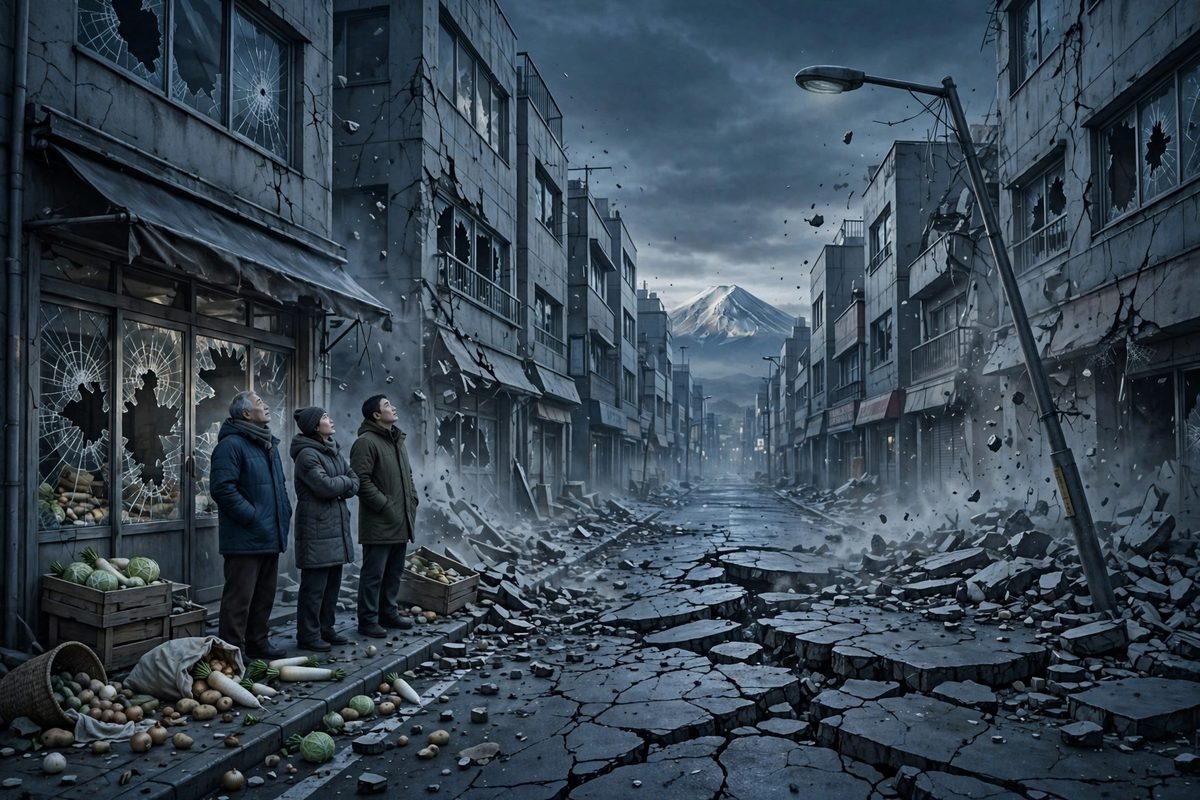

Japan Earthquake: Magnitude 5.7 Shakes Central Japan — 22 Injured as Windows Shatter in Shizuoka
It was 1:04 in the morning when central Japan began to shake. In the darkened streets of Aichi and Shizuoka prefectures, shop windows shattered, goods tumbled from shelves, and people ran from their homes in their nightclothes as a magnitude 5.7 earthquake rolled through one of the country’s most densely populated corridors. By dawn, the toll was becoming clear: at least 22 people injured, railway services disrupted, and a warning from Japan’s Meteorological Agency that stronger tremors could follow in the days ahead.
The quake struck in the early hours of Sunday, 8 November 2026, its epicentre in western Shizuoka Prefecture, about 40 kilometres below the earth’s surface. It was felt across a wide sweep of central Japan — from the industrial city of Hamamatsu to the ancient capitals of Kyoto and Nara, and into Yamanashi, home of Mount Fuji, and Gifu. It was not felt in Tokyo, far from the epicentre, but for those in its path it was a frightening reminder of the ground beneath Japan.
BLUF: A magnitude 5.7 earthquake struck central Japan at 1:04am local time on Sunday, 8 November 2026, injuring at least 22 people in Aichi and Shizuoka prefectures. The Japan Meteorological Agency put the magnitude at 5.7, while the US Geological Survey reported it at 5.5. No tsunami warning was issued, no deaths have been reported, and the Hamaoka nuclear power plant in Shizuoka reported no abnormalities. The agency has warned residents to brace for possible strong quakes in the coming week, especially over the next two to three days.
At a Glance
- The quake: Magnitude 5.7 (Japan Meteorological Agency) / 5.5 (US Geological Survey), at 1:04am JST on Sunday, 8 November 2026 — 16:04 GMT on Saturday.
- Where: Western Shizuoka Prefecture, at a depth of about 40 kilometres. Shaking was recorded across Aichi, Shizuoka, Nagano, Gifu and Yamanashi prefectures, and in Kyoto and Nara.
- Intensity: Upper 5 on the Japanese seismic intensity scale in Chita, Aichi; lower 5 in parts of Aichi, Nagano and Gifu.
- Casualties: At least 22 people injured, according to local media and authorities — most of them minor injuries. No deaths have been reported.
- Damage: Shattered store windows, goods knocked from shelves, and disruption to train services in parts of central Japan.
- Tsunami: No tsunami warning was issued.
- Nuclear safety: No abnormalities were detected at the Hamaoka nuclear power plant in Shizuoka, according to its operator, Chubu Electric Power Co.
- What comes next: The Meteorological Agency has warned of possible strong quakes in the coming week, particularly over the next two to three days.
What Happened in the Early Hours
The tremor arrived without warning in the middle of the night, when most people were asleep. In Aichi Prefecture, emergency officials received 16 reports of mostly minor injuries. In neighbouring Shizuoka, at least three people sought emergency medical care, including a woman in her nineties who injured her shoulder after falling from her bed during the shaking. Local media reported that several of the injured had fallen from stairs while trying to flee their homes.
Video and images from the affected areas showed the familiar aftermath of a strong Japanese quake: shattered shopfront glass scattered across pavements, books and goods strewn across shop floors, and residents gathered outside in the dark. The quake registered upper 5 on Japan’s seven-point seismic intensity scale in Chita, a city in Aichi Prefecture — strong enough to make standing difficult and to topple unsecured furniture. Lower 5 shaking was recorded in parts of Aichi, Nagano and Gifu.
The wide area affected tells its own story. Hamamatsu, a major city in Shizuoka, felt the shaking strongly, as did Kyoto and Nara, the ancient capitals, and Yamanashi, where Mount Fuji stands. The quake was not felt in Tokyo, which lies well to the east of the epicentre — a small mercy for a metropolitan area of nearly 40 million people.
Why the Numbers Differ — and What They Mean
As with most earthquakes, the first reports carried slightly different figures. Japan’s Meteorological Agency put the magnitude at 5.7; the US Geological Survey reported it at 5.5. The difference is normal: agencies use different measurement methods and station networks, and early estimates are routinely revised as more data comes in.
The injury count has also moved as reports have come in. The Associated Press, citing local media, reported at least 22 people injured, while the local Chunichi Shimbun newspaper and Tokai Television separately reported at least 24 hurt across Aichi and Shizuoka. What is consistent across every account is that the injuries were overwhelmingly minor, that no one was killed, and that the damage was largely limited to broken glass, fallen goods and transport disruption rather than collapsed buildings — a reflection of Japan’s strict building codes as much as of the quake’s moderate size.
The depth of the quake — about 40 kilometres — also matters. Deeper earthquakes tend to spread their energy over a wider area while producing less violent shaking at any single point, which matches what happened here: a broad area felt the tremor, but nowhere did it reach the destructive intensities seen in Japan’s worst disasters.
The Aftershock Warning
The most important message from the authorities is not about the quake that happened, but about the ones that might follow. The Meteorological Agency warned people to brace for possible strong quakes in the coming week, especially over the next two to three days. Smaller aftershocks have already been reported.
That warning is standard practice in Japan, where a moderate quake can be a foreshock to something larger, and it carries real weight: residents in the affected prefectures have been urged to check their homes for damage, secure furniture, and keep emergency supplies close at hand.
There was also reassurance on one front that always draws attention after a Japanese earthquake. Chubu Electric Power Co., operator of the Hamaoka nuclear power plant in Shizuoka, said no abnormalities were detected at the facility — a significant detail given the plant’s location in one of Japan’s most seismically active regions.
Japan’s Uneasy Relationship With the Ground Beneath It
Earthquakes are a fact of life in Japan, which sits on the Pacific Ring of Fire where four tectonic plates meet. The country experiences around 1,500 tremors a year that are strong enough to be felt, and its building standards, early-warning systems and public drills are among the most advanced in the world.
That preparedness is why a magnitude 5.7 quake in the middle of the night produced injuries measured in dozens rather than hundreds, and why the story of this earthquake is one of broken glass and disrupted trains rather than of collapsed buildings. But the warning of further shaking in the coming days is a reminder that in Japan, the ground is never entirely still — and that the hours after a quake matter as much as the quake itself.
People Also Ask
How strong was the earthquake in Japan on 8 November 2026?
The Japan Meteorological Agency put the earthquake at magnitude 5.7, while the US Geological Survey reported it at magnitude 5.5. It struck at 1:04am local time on Sunday, 8 November 2026, in western Shizuoka Prefecture at a depth of about 40 kilometres, and registered upper 5 on the Japanese seismic intensity scale in Chita, Aichi.
How many people were injured in the Japan earthquake?
At least 22 people were injured in Aichi and Shizuoka prefectures, according to local media and authorities cited by the Associated Press. Some local outlets, including the Chunichi Shimbun and Tokai Television, reported at least 24 people hurt. Most injuries were minor — people falling while fleeing their homes — and no deaths have been reported.
Was there a tsunami warning after the Japan earthquake?
No. The Japan Meteorological Agency did not issue a tsunami warning after the magnitude 5.7 quake, and no tsunami was reported. The agency did, however, warn residents to prepare for possible strong earthquakes in the coming week, especially over the next two to three days.
Was the Hamaoka nuclear power plant affected by the earthquake?
No abnormalities were detected at the Hamaoka nuclear power plant in Shizuoka Prefecture, according to its operator, Chubu Electric Power Co. The plant sits in one of Japan’s most seismically active regions, and its safety systems were checked immediately after the quake.