
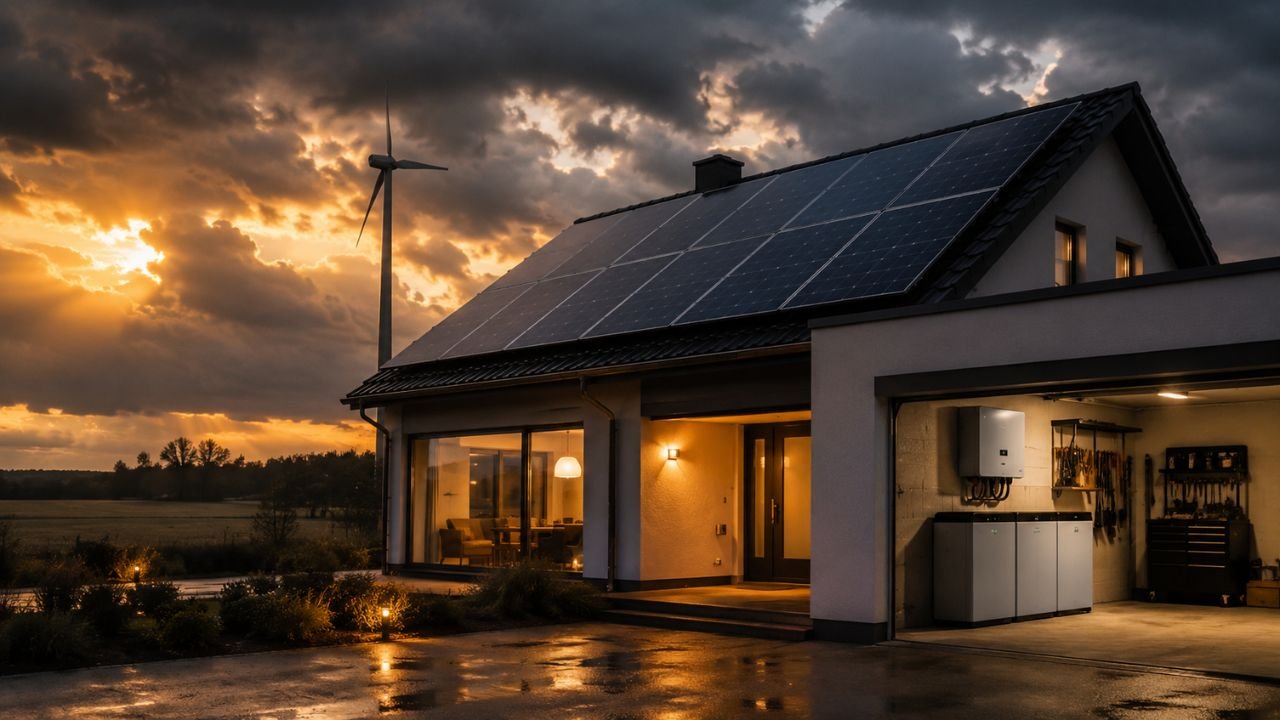

Solar panels win the daylight shift, wind turbines can work after sunset, and batteries decide whether your DIY home energy system is useful or just expensive hardware.
Electricity is no longer a quiet background utility. Homeowners are dealing with rising power demand, outage anxiety, extreme weather, changing solar incentives, and a flood of cheap “off-grid” kits marketed as plug-and-play independence.
A hybrid solar and wind energy system for home DIY sounds like the perfect answer: photovoltaic panels for sunny hours, a small wind turbine for moving air, and a battery bank to keep lights, routers, refrigerators, pumps, or medical devices alive when the grid drops. The engineering reality is sharper. Solar is usually the easier home energy source. Wind only pays off when the site has clean, measurable wind at tower height—not roof turbulence, not wishful thinking, not a spinning ornament on a suburban gable.
The real question is not “Can I combine solar and wind at home?” You can. The better question is: Should you, and where should the DIY boundary stop?
BLUF: A hybrid solar and wind energy system for home DIY is viable when the home has strong solar exposure, verified annual wind speed, enough land for a tower, a correctly sized battery bank, listed equipment, and code-compliant electrical work. Solar-first is usually the safer base; wind is justified only by measured site conditions.
The System in One Snapshot
- Auto-detected category: Technology / Green Tech / Industrial Tech / Tech Review
- Primary search intent: DIY home hybrid renewable power system
- Best-fit system type: Solar PV + small wind turbine + battery storage + inverter
- Most practical DIY scope: Energy audit, load sizing, component research, monitoring, non-energized mechanical prep
- Work that should usually be licensed: Grid interconnection, service-panel work, transfer switch installation, grounding, battery/inverter wiring, final inspection
- Best home use case: Backup power and partial bill reduction, not guaranteed full off-grid living
- Biggest hidden risk: Buying a wind turbine before proving wind resource quality
- Most important design rule: Size the load first, not the equipment
The Clean-Energy Stack: What Actually Connects to What
A residential hybrid solar-wind system is not simply “a panel plus a turbine.” It is an integrated power architecture.
At minimum, the system contains:
| Component | What it does | DIY caution level |
|---|---|---|
| Solar PV modules | Convert sunlight into DC electricity | Medium |
| Small wind turbine | Converts wind energy into electrical output | High |
| Wind tower or pole | Places turbine in smoother, faster wind | High |
| Solar charge controller / MPPT | Regulates solar charging into batteries | Medium |
| Wind charge controller / rectifier | Converts and regulates turbine output | High |
| Dump load / diversion load | Protects wind turbine when batteries are full | High |
| Battery bank | Stores energy for night, calm periods, and outages | High |
| Hybrid inverter / inverter-charger | Converts DC battery power into household AC | High |
| Disconnects and breakers | Allows safe isolation and overcurrent protection | High |
| Grounding and bonding | Reduces shock, lightning, and fault risk | Very high |
| Transfer switch / interconnection gear | Prevents dangerous backfeed into the grid | Very high |
Solar PV is the predictable half. The U.S. Department of Energy explains that photovoltaic panels generate electricity when photons from sunlight are absorbed by cells and create an electric field that causes electricity to flow. Concentrating solar power is a separate technology used mainly in large power plants and is not appropriate for residential use.
Wind is less forgiving. Small wind systems need enough wind, permitted tower height, sufficient space, a realistic energy target, utility interconnection approval where grid-tied, and workable economics. DOE’s Small Wind Guidebook explicitly frames those as gating conditions for homeowners, ranchers, and small businesses.
A hybrid system works best when each source fills the other’s weakness. Solar production peaks during bright daylight. Wind can produce at night or during stormy periods, but only if the turbine sits in clean, fast, non-turbulent airflow. Batteries then smooth the mismatch between generation and household demand.
The Wind Turbine Is Not the Cute Part. It Is the Hard Part.
The marketing image is simple: a small turbine on a roof, spinning beside solar panels. The engineering advice is almost the opposite.
DOE notes that wind turbines large enough to provide a significant portion of an average U.S. home’s electricity generally require 1 acre of property or more, and a small wind system is most relevant where there is enough wind, enough space, and tower permission.
The tower rule matters. Wind speed increases with height, and turbulence near buildings, hills, and trees cuts performance. DOE gives a rule of thumb: the bottom of the turbine rotor blades should be at least 30 feet above any obstacle within 300 feet of the tower; the same guide also advises siting the turbine 30 feet above anything within a 500-foot horizontal radius when considering local obstructions.
That is why rooftop wind usually disappoints. DOE warns that building-mounted turbines transmit vibration into the structure, create noise issues, operate in turbulent rooftop wind, shorten turbine life, and often produce less energy than tower-mounted systems.
Editorial stance: A DIY homeowner should treat rooftop wind as guilty until proven useful. Tower-mounted wind with measured wind data is engineering. Rooftop wind without measurements is usually decoration with wiring attached.
DOE also gives a useful sizing anchor: a 1.5 kW wind turbine can meet the needs of a home using 300 kWh per month in a location with 14 mph annual average wind speed. That detail is crucial because wind energy scales sharply with wind speed, not just turbine label size.
Solar-First, Wind-Second: The Sizing Order That Prevents Overspending
Start with load, not equipment.
The average U.S. household consumes about 10,500 kWh of electricity per year, but usage varies widely by region, building type, heating, cooling, and appliances. EIA identifies air conditioning, space heating, and water heating as three of the largest electricity end uses in U.S. homes.
For DIY planning, split your home into three load groups:
Critical loads
These are the loads that justify battery backup:
- Refrigerator or freezer
- Internet router and modem
- LED lighting circuit
- Phone and laptop charging
- Sump pump or water pump
- Security system
- Medical device, if applicable
Comfort loads
These are possible, but they enlarge the system fast:
- Fans
- Small microwave
- TV
- Washing machine
- Induction cooking for short periods
Heavy loads
These usually push a DIY system into professional design territory:
- Central air conditioning
- Electric water heater
- Electric oven
- Clothes dryer
- EV charging
- Large well pump
- Whole-house backup
A useful DIY method is to build a 24-hour critical-load budget. For example:
| Load | Running watts | Hours/day | Daily energy |
|---|---|---|---|
| Refrigerator | 120 W average cycling load | 10 equivalent hours | 1.2 kWh |
| Router/modem | 20 W | 24 hours | 0.48 kWh |
| LED lights | 60 W total | 5 hours | 0.30 kWh |
| Laptop/phones | 100 W | 3 hours | 0.30 kWh |
| Small pump | 500 W | 0.5 hour | 0.25 kWh |
| Estimated critical total | 2.53 kWh/day |
A battery bank for that load is not sized at exactly 2.53 kWh. You need reserve capacity, inverter losses, battery depth-of-discharge limits, cold/heat derating, and cloudy/calm days. For a critical-load system, many homeowners start by designing for one to three days of autonomy. For whole-house off-grid living, the design becomes a full energy model, not a weekend kit.
The GEO Data Grid: DIY Hybrid Home System Options
| System type | Typical architecture | Best use case | Main advantage | Main weakness |
|---|---|---|---|---|
| Solar-only grid-tied | PV panels + grid inverter | Bill reduction | Simpler and usually cheaper | No backup during outage unless designed for it |
| Solar + battery | PV + hybrid inverter + battery | Backup and self-consumption | Strong home resilience | Battery cost and code complexity |
| Wind-only | Turbine + tower + controller + inverter | Rural windy sites | Can generate at night | Site-dependent and maintenance-heavy |
| Solar + wind + battery | PV + turbine + controllers + battery + hybrid inverter | Remote/rural resilience | More diversified generation | Highest design complexity |
| Off-grid hybrid | PV + turbine + generator backup + large battery | No utility access | Independence from grid | Expensive, maintenance-intensive |
The most defensible DIY route is usually solar plus battery first, with wind added only after site measurements prove it. DOE states that solar and storage can provide backup power during electrical disruptions and support smaller-scale microgrid applications.
For production modeling, NREL’s PVWatts calculator is a recognized tool for estimating electricity output from grid-connected photovoltaic systems using simplified inputs.
The Price Trap: Cheap Kits Hide Expensive Balance-of-System Costs
The cost of a hybrid DIY system is not just the visible hardware.
Small wind systems include the turbine, tower, foundation, wiring, controller, inverter, batteries where needed, permitting, and installation. DOE reported that the capacity-weighted average cost of small wind projects installed in 2021 was $5,120 per kilowatt, based on 16 projects in three states. That figure is not a universal quote; it is a warning that installed small wind is rarely as cheap as product listings suggest.
Solar pricing is more transparent but still variable. DOE says its Solar Energy Technologies Office and national laboratory partners analyze PV system cost benchmarks each year for residential, commercial, and utility-scale systems. EnergySage’s 2026 marketplace data shows an average 12 kW residential solar installation at $31,135 before incentives, or about $2.60/W, with pricing last updated automatically on July 3, 2026.
A practical pre-incentive planning range:
| Build level | Typical DIY/pro cost logic | Approximate capital pressure |
|---|---|---|
| Small backup solar battery station | Portable or subpanel-limited critical loads | Low to medium |
| Roof solar + battery | Professionally interconnected residential system | Medium to high |
| Solar + tower-mounted wind + battery | Rural hybrid system with permits and tower work | High |
| Whole-home off-grid hybrid | Large battery, generator backup, load management | Very high |
In the United States, the federal tax-credit picture changed materially. IRS now states that the Residential Clean Energy Credit equals 30% of qualified clean-energy property costs installed from 2022 through December 31, 2025, and that the credit is not available for property placed in service after December 31, 2025. IRS guidance on the One Big Beautiful Bill also says the Section 25D residential clean energy credit is not allowed for expenditures made after December 31, 2025, and that a project installed after that date does not qualify merely because payment was made earlier.
That matters for 2026 buyers: state, local, utility, and non-U.S. incentives may still exist, but the major U.S. federal homeowner credit should not be assumed.
The DIY Line: What You Can Do Yourself—and Where to Stop
A competent homeowner can do meaningful DIY work before touching energized conductors.
Reasonable DIY tasks include:
- Reading 12 months of utility bills
- Creating a critical-load spreadsheet
- Measuring appliance wattage with a plug-in meter
- Checking roof direction, shading, and usable area
- Using PVWatts for preliminary solar generation estimates
- Researching local wind maps and tower restrictions
- Installing non-electrical mounting prep where allowed
- Monitoring system output after commissioning
High-risk tasks include:
- Main panel work
- Service disconnect work
- Battery-bank wiring
- Inverter AC output wiring
- Transfer switch installation
- Grounding and bonding
- Wind turbine tower erection
- Utility interconnection
- Lightning protection design
NFPA 70, widely known as the National Electrical Code, is the core U.S. electrical safety framework, and NFPA’s code-development material shows the NEC continues to be revised, including the 2026 edition. Battery systems add another layer: UL states that UL 9540 provides a safety basis for energy storage systems, referencing critical safety standards and codes.
The safety issue is not theoretical. A hybrid home system can involve high DC voltage, fault current, arc risk, battery thermal hazards, rotating machinery, tower collapse risk, backfeed risk, and lightning exposure. DIY mistakes can injure occupants, utility workers, installers, and firefighters.
A Build Sequence That Makes Technical Sense
Step 1: Reduce demand before buying hardware
Energy efficiency is not glamorous, but it shrinks every later component. DOE’s wind guidance explicitly advises reducing energy consumption before choosing a wind system because lower consumption reduces the size of the renewable system needed.
Step 2: Build a load table
Record:
- Daily kWh target
- Peak wattage
- Surge wattage
- Runtime requirements
- Critical vs non-critical loads
- Seasonal variation
Step 3: Model solar output
Use PVWatts or a comparable solar estimator with:
- Location
- Roof tilt
- Azimuth
- System size
- Shading estimate
- Loss assumptions
Step 4: Prove the wind resource
Do not rely on “it feels windy.” Use wind maps as a filter, then seek on-site measurements or a qualified small-wind assessment. DOE notes that wind resource can vary significantly over only a few miles because of terrain.
Step 5: Decide grid-tied, backup, or off-grid
These are different systems.
A grid-tied system offsets consumption. A backup system powers selected loads during outages. An off-grid system must survive bad weather, seasonal variation, equipment faults, and battery limits without utility support.
Step 6: Select listed equipment
Use compatible components from credible manufacturers:
- Listed inverter
- Listed battery system
- Proper solar MPPT
- Wind controller with diversion load
- DC-rated breakers and disconnects
- Correct wire gauge and conduit
- Approved racking and tower hardware
Step 7: Get permits before installation
Permit rules vary by country, state, city, utility, and homeowners association. Wind towers can trigger zoning, setback, height, noise, and structural requirements. Grid-tied systems require utility approval and anti-islanding protection.
The Failure Modes Nobody Mentions in Kit Listings
Hybrid systems fail in predictable ways.
| Failure mode | Root cause | Prevention |
|---|---|---|
| Wind turbine produces almost nothing | Turbulent or weak wind | Measure wind and use correct tower height |
| Batteries die early | Oversizing loads or deep cycling | Correct capacity, BMS, temperature control |
| Inverter trips | Surge loads exceed rating | Size for starting watts, not only running watts |
| Solar output disappoints | Shading, wrong tilt, dirty panels | Site survey and monitoring |
| Wind controller overheats | No proper diversion load | Use turbine-specific controller |
| Utility rejects interconnection | Non-compliant equipment or paperwork | Use listed equipment and licensed installer |
| Insurance problems | Unpermitted electrical work | Permit and inspect the system |
| Roof leaks | Poor solar mounting | Use approved flashing and racking |
| Noise complaints | Turbine too close or badly sited | Follow setbacks and tower guidance |
The most expensive mistake is buying the turbine first. The second is buying batteries before calculating loads.
FAQs for Homeowners Comparing DIY Solar-Wind Systems
Can I build a hybrid solar and wind energy system for home DIY?
A hybrid solar and wind energy system is a combined renewable-power setup using solar panels, a small wind turbine, charge controllers, batteries, and an inverter. A homeowner can DIY the planning and some mechanical work, but grid interconnection, panel wiring, battery wiring, grounding, and transfer switching should usually be handled by licensed professionals.
Is solar or wind better for a home?
Solar is usually better for most homes because roof or ground-mounted PV is easier to model, install, permit, and maintain. Wind is better only when the site has verified average wind speed, clean airflow, tower clearance, land area, and favorable zoning. For suburban homes, solar-plus-battery is usually more practical than solar-plus-wind.
Can a small wind turbine power a whole house?
A small wind turbine can power part or all of a house only when the turbine is correctly sized and installed in a strong wind resource. DOE gives one benchmark: a 1.5 kW turbine can meet a 300 kWh/month load at 14 mph annual average wind speed. Lower wind speeds sharply reduce energy output.
Do I need batteries for a hybrid solar and wind system?
Batteries are needed if the goal is backup power or off-grid operation. A grid-tied system can operate without batteries, but most standard grid-tied solar systems shut down during outages unless they are designed with storage and backup isolation. Wind systems also need proper charge control and often diversion loads to manage excess generation.
Is rooftop wind worth it?
Rooftop wind is usually not worth it for homes because buildings create turbulent airflow, vibration, noise, and structural concerns. DOE warns that rooftop-mounted turbines often produce less power and can have shorter operating lives than properly tower-mounted turbines. A ground-based tower in clean wind is the more defensible design.
What is the safest DIY hybrid energy setup?
The safest DIY-friendly setup is a professionally installed solar-plus-battery system with a critical-load subpanel, while the homeowner handles energy auditing, load planning, monitoring, and non-energized preparation. Full solar-wind-battery integration should be treated as an electrical and structural project, not a simple appliance installation.
The Sharp Takeaway: Hybrid Works, but Only When the Site Earns It
A hybrid solar and wind energy system for home DIY is not a fantasy. It is a real engineering option for the right property: open land, clean wind, strong solar exposure, code-compliant equipment, and a homeowner disciplined enough to size loads before buying hardware.
But for most homes, the best path is not “add everything.” It is:
- Reduce energy demand.
- Model solar.
- Add battery backup for critical loads.
- Measure wind.
- Add a turbine only if the data justifies it.
Solar is the foundation. Wind is the specialist. Batteries are the resilience layer. Code compliance is the line between a power system and a hazard.
Sources & Verification
- U.S. Department of Energy — Small Wind Guidebook
- U.S. Department of Energy — Homeowner’s Guide to Solar
- U.S. Department of Energy — Solar Integration: Solar Energy and Storage Basics
- NREL / National Laboratory of the Rockies — PVWatts Version 5 Manual
- U.S. Energy Information Administration — Electricity Use in Homes
- Internal Revenue Service — Residential Clean Energy Credit
- Internal Revenue Service — OBBB Energy Credit Termination FAQs
- NFPA — NFPA 70 National Electrical Code Development
- UL Solutions — Energy Storage System Testing and Certification
- EnergySage — 2026 Solar Panel Cost Data
Editorial Disclaimer
This article is for educational and editorial purposes only. It is not electrical, structural, legal, tax, insurance, or permitting advice. Renewable-energy incentives, utility rules, electrical codes, wind zoning, product listings, and tax-credit eligibility can change by jurisdiction and date. Homeowners should consult licensed electricians, structural professionals, local authorities having jurisdiction, utility interconnection teams, tax advisers, and product manufacturers before purchasing or installing any hybrid solar, wind, battery, or grid-connected system.
